
The Rising Bengal - The Bengal Renaissance 2.0: Why West Bengal Emerges as India’s Newest Industrial Frontier After the 2026 Elections
Why West Bengal Emerges as India’s Newest Industrial Frontier After the 2026 Elections
5/4/20263 min read

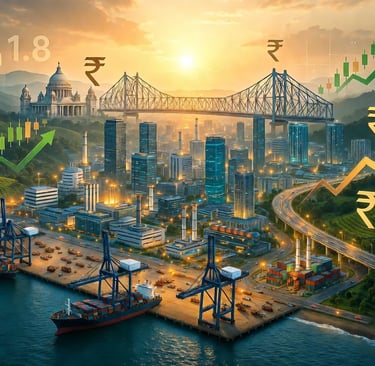
On May 4, 2026, West Bengal witnessed a historic political shift as the BJP secured a decisive victory in the state assembly elections, crossing the majority mark comfortably and ending over a decade of Trinamool Congress rule. Prime Minister Narendra Modi, addressing party workers from BJP headquarters, described it as the “lotus blooming in West Bengal” and declared that “Bengal has become bhay-mukt (fear-free) and is now filled with the confidence of vikas (development).” He emphasized that a new journey of progress has begun, with poriborton (change) delivering opportunity, dignity, and development to every corner.
This mandate has ignited strong optimism among businesses and investors. For decades, perceptions of labor issues, political friction, and industrial slowdown held the state back. Post-results, the focus is rapidly shifting to policy execution, reduced red tape, and aggressive industrialization. Here’s a data-backed overview of what’s happening on the ground and why Bengal is emerging as one of India’s most promising investment destinations.
1. The Massive Investment Push and 100-Day RoadmapThe state has targeted large-scale investments, building on events like the Bengal Global Business Summit (BGBS). Earlier proposals reached around ₹1.8–4.4 lakh crore in various cycles, with a strong emphasis on converting MoUs into on-ground projects. The incoming administration is widely expected to fast-track a 100-day industrialization roadmap featuring:
Strengthened Silpa Sathi single-window clearance system (integrating 40+ services).
Faster land allotment, environmental clearances, and approvals.
Leveraging Bengal’s strategic geography — the only Indian state offering a Himalayas-to-Sea corridor and direct ASEAN access via the Northeast, supported by national projects like the Kolkata-Amritsar Dedicated Freight Corridor.
PM Modi’s repeated emphasis on vikas and jobs signals central-state synergy to accelerate these efforts.
2. Tajpur Deep Sea Port: Eastern Trade GatewayThe Tajpur Deep Sea Port (~₹25,000 crore project) is a transformative initiative. With a draught capable of handling capesize vessels (unlike riverine Kolkata/Haldia ports), it aims to cut logistics costs for steel, iron ore, seafood, and bulk exports by 20-30%. Under the new political stability, faster execution, better connectivity (rail/highways), and an industrial maritime cluster could position Bengal as India’s eastern gateway to global trade.
3. Power Sector Modernization and CESC OpportunityReliable power is critical for manufacturing revival. CESC Ltd (RP-Sanjiv Goenka Group) remains a bright spot with high operational efficiency. Discussions around grid modernization via PPP models in industrial belts, renewable integration (e.g., pumped storage like the Turga project), and making Bengal power-surplus are gaining momentum. Modi’s development-focused speech reinforces the priority on infrastructure that supports industry and youth employment.
4. Bandhan Bank and Rural Economic Boost
Bandhan Bank (Kolkata-headquartered) benefits from improved rural stability. Better collection efficiencies in microfinance, smoother operations, and a pivot to diversified retail banking can drive consumption in districts like Murshidabad and Hooghly — creating ripple effects in FMCG, agriculture equipment, and construction.
5. Reviving Legacy Sectors: Jute and Darjeeling Tea
Jute: West Bengal accounts for the lion’s share of India’s production. Global anti-plastic trends position “Golden Fibre” for sustainable packaging and geo-textiles, supported by tech upgrades and policy focus.
Darjeeling Tea: Blockchain traceability and premium branding aim to boost export realizations. These heritage sectors align with broader industrialization and export goals.
6. Real Estate and Land Reforms: Unlocking Potential
Easier land acquisition, leasehold-to-freehold conversions, PMAY housing push, and Kolkata Metro expansions are catalyzing activity in New Town, Rajarhat, and southern corridors. Builders are actively positioning for the expected surge.Key Economic Indicators
GSDP: Strong nominal growth trajectory, with recent years showing performance at or above national averages in projections.
MSMEs: Over 90 lakh units — among India’s highest.
IT & Exports: Momentum via projects like Bengal Silicon Valley and engineering goods.
PM Modi’s Vision for Bengal’s ProgressIn his victory speech, PM Modi highlighted three core guarantees: safety for women, jobs for youth in Bengal itself, and development reaching every corner. He urged a shift from “badla” (revenge) to “badlav” (change), focusing entirely on vikas. This aligns with BJP’s campaign pitch on industrial revival, employment generation, and infrastructure — promising smoother central fund flows and execution.
The Road AheadChallenges persist — swift project execution, skills development, and inclusive growth. However, the decisive mandate, combined with strategic location, skilled workforce, improving logistics, and policy clarity, positions West Bengal strongly.Businesses that move first — engaging with single-window systems, infrastructure partnerships, and sector-specific opportunities — will lead the charge. As PM Modi noted, a new chapter of bhay-mukt, vikas-yukt Bengal has begun.
Bengal is open for business — and this time, it aims to be historic.
The question for investors is: Who will show up first?

Email: hr@risingindia.in for opportunities
Stay connected on:
Copyright © 2026 all rights reserved
Unleash Your Entrepreneurial Spirits
“We believe in peace and peaceful development, not only for ourselves but for people all over the world”
List your Startup
Schedule time with us to connect with founding team
Join Next Startups